Shanghai, 11 August 2026 – The Asia-Pacific Typhoon Collaborative Research Center (AP-TCRC) and the Pakistan Meteorological Department (PMD) signed the Agreement on Collaborative Research in Shanghai, marking a formal milestone in bilateral meteorological collaboration.
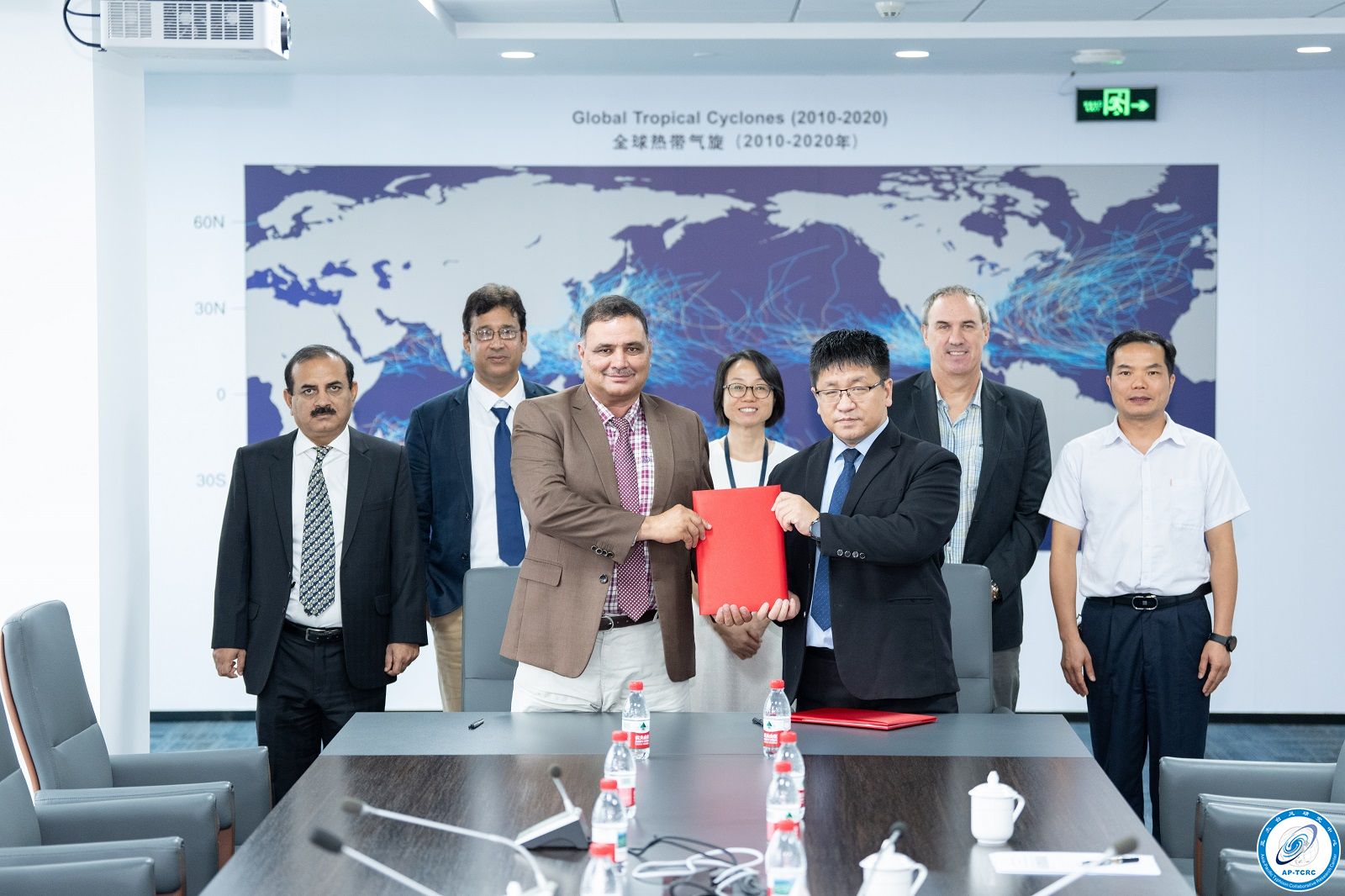
The signing ceremony was held in a hybrid format at the Shanghai Lingang Special Area, with Dr. Tang Jie, Director of AP-TCRC, delivering opening remarks. He noted that the agreement represents AP-TCRC’s formal partnership with PMD and marks a significant milestone. Dr. Zaheer Ahmad Babar, Director General of PMD, joined online and referred to the signing as “a beginning, not an end,” urging swift implementation of researcher exchanges, joint training, and collaborative technology development.
Dr. Duan Yihong, Secretary of the ESCAP/WMO Typhoon Committee, delivered an address affirming the agreement’s significance in strengthening regional resilience and enhancing collective disaster risk reduction capacity. Mr. Chen Haitao of the China (Shanghai) Pilot Free Trade Zone Lin-gang Special Area Administration, emphasized the borderless nature of meteorological hazards and expressed hope that the agreement would serve as a bridge for deeper international scientific cooperation.
During the technical session, Dr. Yu Zifeng, Deputy Director of AP-TCRC, presented the center’s recent progress, including dual-aircraft typhoon observation experiments with Hong Kong/China, development of the Global Tropical Cyclone Data Center, and AI applications in tropical cyclone areas. Dr. Shahzad Sultan, Deputy Director of Coord. & Int’l Cooperation of PMD, outlined Pakistan’s meteorological infrastructure and highlighted the growing threat of tropical cyclones in the North Indian Ocean and Arabian Sea due to climate change.
The agreement establishes a framework for collaboration in tropical cyclone research, including exchanges of forecasters and researchers, the sharing of research and forecast information and techniques, joint conferences and training programs, and joint research activities such as field campaigns and forecast technique development. Both sides agreed to prioritize researcher exchanges, joint training programs, and collaborative projects to produce early results.
The signing lays a solid foundation for deeper collaboration in tropical cyclone research and forecasting, contributing to enhance disaster resilience across the Asia-Pacific region.